
Mission Architecture
Intermodal space transport.
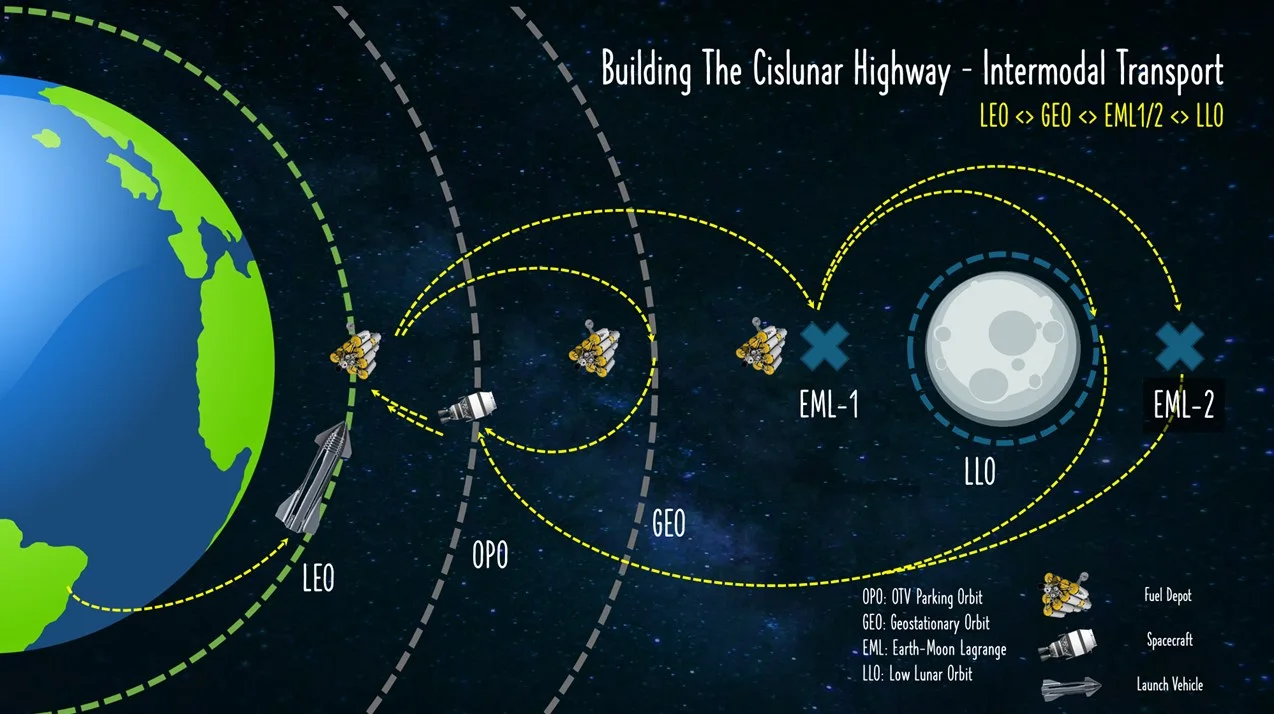
No shipping company sends trucks across the ocean. Space logistics has the same structure: distinct legs with distinct physics, each rewarding a different propulsion mode. Chemical wins the climb to orbit. Nuclear thermal wins the legs after that.
The rocket equation, worked
Why 900 seconds changes the business.
Take a 10-metric-ton payload from low Earth orbit to the lunar vicinity, about 3.9 km/s of ΔV. A chemical stage at 450 s needs a mass ratio of e3900/(9.81·450) ≈ 2.42: for every kilogram arriving, 1.4 kilograms of propellant burned on the way. Run the same leg at 900 s and the mass ratio drops to about 1.56. The propellant bill falls by nearly two thirds, and everything downstream of that number, launch cost, tanker cadence, delivered cargo per year, falls with it.
Electric propulsion pushes specific impulse higher still, but pays in thrust: milligees, spiral trajectories, and trip times measured in months, with slow transits through the radiation belts. NTP is the only mode that combines chemical-class trip times with roughly double chemical efficiency. Adjust the assumptions below and watch how robust that ordering is.
See for yourself: every assumption is a slider. Try to make the ordering come out differently.
Initial mass in LEO (lower is cheaper to launch)
Trip time, one way
Same payload, same trip time: NTP launches 11.9 t less than chemical (41% of the chemical stack) on this leg.
First-order model. Impulsive transfers coast ~4.5 days; NEP flies a field-free spiral at 8.0 km/s equivalent ΔV with 60% thruster efficiency and 10% tankage. Chemical stage dry mass is 12% of propellant. Hatched bar means the rocket equation refuses: dry mass growth outruns the propellant you add. The point is the ordering, and the ordering survives any honest setting of these sliders.
Want a deeper, stage-by-stage look at NTP against the chemical competition? Our published comparison tool puts a DARKFORCE-class stage side by side with hydrogen/oxygen and methane/oxygen stages, with the parameters under your control. It was built to be a fair fight: pick the numbers you believe and see what survives.Open the comparison tool →
What this enables
Recurring cislunar logistics
A reusable DARKFORCE orbital transfer vehicle running the LEO-to-lunar-vicinity circuit: more delivered mass per launched tonne, on schedules chemical economics can't sustain.
Maneuver without regret conviction
In national security applications, ΔV is operational freedom. A high-Isp, high-thrust vehicle holds maneuver reserve that lets operators act without spending the mission to do it.
Faster deep space science
The same engine cuts transit times to Mars and enables outer-planet trajectories that chemistry cannot close at meaningful payload fractions.
Depot-compatible by design
Hydrogen is the common denominator of the emerging propellant economy. DARKFORCE is designed to be a customer of on-orbit propellant infrastructure, not a competitor to it.
The Other Gate
The license is part of the vehicle.
For most space companies, regulation is overhead. For a space nuclear company, the launch approval pathway is a binding design constraint with the same standing as a thermal margin: NSPM-20 tier determination, FAA Part 450 licensing with nuclear-specific safety analysis, and the NRC/DOE materials framework sit on the critical path exactly as the engine does. We treat the license as an engineered artifact, built with the same analysis discipline as the hardware.
The approval problem has quantitative structure, and the structure favors a well-designed program. Authorization tiers scale with the radioactive material aboard and the credible exposure it could produce, and fresh, unirradiated fuel is only barely radioactive: a nuclear rocket's radiological inventory is not carried up the gravity well, it is produced later, in orbit, by operating the reactor. Launch cold and start high, and the launch source term becomes small, bounded, and analyzable.
That is why our first flight, DARK SCOUT, is a deliberate regulatory pathfinder: a small quantity of commercial-grade fissile material, the first U.S. flight of enriched nuclear fuel in nearly six decades, flown specifically to exercise the full approval chain end to end. The precedent it sets applies to every space nuclear system that follows: nuclear thermal, nuclear electric, and fission surface power alike.
We know this terrain because we have worked it from the government side of the table: our founders have run interagency programs and processes from inside DARPA, the White House Office of Science and Technology Policy, and the Space Development Agency.Read the white paper →